
Going Over Your Manager’s Head: Accountability or Organizational Betrayal?

How bypassing management, organizational silence, and misplaced authority can quietly undermine trust, accountability, and organizational growth.
Introduction: One Decision, Two Managers, and a Confused Organization
Going over your manager’s head is justified when a material concern cannot be resolved through an appropriate, safe route—or when misconduct, retaliation risk, or immediate danger makes that route unsuitable. Seeking a different answer to an ordinary disagreement is a different matter. The relevant test is the concern, the process, and who remains accountable afterward.
Imagine an employee who disagrees with a decision made by their direct manager. Instead of discussing the disagreement, presenting evidence, or following an established escalation process, the employee approaches the manager’s superior. The senior leader listens, agrees with the employee, and overrides the original decision.
Problem solved, right? Not necessarily. The employee gets the outcome they wanted. The senior leader feels they have removed an obstacle. The organization may even move faster in the short term.
But something less visible may have happened. A manager who remains accountable for their team’s results has just been excluded from a decision affecting those results. An employee has learned that an unfavorable decision can potentially be reversed by approaching someone with greater authority.
And a senior leader may have unintentionally become an alternative decision-maker for matters that should ordinarily be resolved within the team. Individually, such incidents may appear insignificant. Repeated across an organization, however, they can create a much larger problem: a gradual separation of authority, accountability, and trust.
Yet concluding that employees should never approach higher management would be equally problematic. Some managers make poor decisions. Some create unnecessary barriers. Others discourage constructive criticism, suppress important information, or abuse their authority. Employees must have legitimate ways to challenge decisions and report misconduct.
The real question, therefore, is not whether going over your manager’s head is always right or wrong. It is:
When does bypassing a manager become destructive organizational behavior, and when does escalation become a necessary act of professional responsibility?
1. Bypassing Management Is Not the Same as Escalation
One of the most common organizational mistakes is treating every communication outside the formal reporting structure as a violation of the chain of command. In reality, several fundamentally different behaviors are often grouped together.
| Concept | Definition | Organizational Implication |
|---|---|---|
| Bypassing Management | Seeking a different decision or approval from higher management while circumventing an established decision-making process | Can undermine accountability and trust |
| Formal Escalation | Referring an unresolved issue to an authorized higher level through an appropriate process | Often necessary and legitimate |
| Skip-Level Communication | Communication between an employee and their manager’s manager | Can strengthen visibility and organizational learning |
| Whistleblowing | Disclosing specified wrongdoing; legal definitions and protection depend on jurisdiction and reporting conditions | Use appropriate independent or designated channels; a personal grievance is not automatically a protected disclosure |
These distinctions matter. A skip-level conversation is a communication channel; it does not, by itself, transfer decision rights. Formal escalation requests an authorized review. Bypassing your boss becomes problematic when informal access replaces the agreed review process rather than helping an unresolved concern reach it. An employee who secretly approaches a senior executive simply because their manager rejected a proposal is not necessarily acting in the organization’s best interests. But an employee reporting harassment, fraud, retaliation, or a serious compliance issue should not be forced to obtain permission from the very manager involved.
Acas guidance for workplaces in Great Britain allows for approaching another manager or HR where speaking to the line manager is uncomfortable. Its statutory Code says formal grievances should go to a manager who is not the subject of the grievance. This is a jurisdiction-specific example of procedural design, not a statement of universal employment law.
Source: Acas — Grievance Procedures
The objective of organizational hierarchy should never be to make managers immune to criticism. Its purpose is to clarify responsibility, decision rights, and accountability.
2. The Hidden Organizational Cost of Going Over Your Manager’s Head
The mechanisms in this section are managerial hypotheses about decision-system design. They explain risks leaders should investigate; they do not establish that every bypass causes disengagement, mistrust, or poor performance.
2.1 Authority Without Accountability — and Accountability Without Authority
One of the fundamental tensions in management is the relationship between decision-making authority and responsibility for outcomes. Managers are expected to deliver results through their teams. They allocate resources, establish priorities, manage people, and translate business strategies into execution.
But what happens when decisions affecting those responsibilities are repeatedly made without their involvement? The organization creates a structural contradiction. Managers remain accountable for outcomes they may no longer have sufficient authority to influence.
Over time, this can encourage defensive management, unnecessary approval-seeking, and reduced ownership of decisions.
An organization cannot consistently demand ownership while systematically undermining the authority required to exercise it.
2.2 The Emergence of Parallel Power Structures
When employees discover that decisions can be reversed through informal access to higher management, the organization may unintentionally encourage a behavior resembling approval shopping. Instead of improving their argument, presenting evidence, or resolving disagreement professionally, individuals may search for someone powerful enough to approve their preferred outcome. Decision quality then risks becoming secondary to personal access.
Those with stronger informal relationships may gain disproportionate influence, even when their arguments are not necessarily stronger. This is particularly damaging in organizations that claim to operate through clear ownership, accountability, and measurable performance.
2.3 The Erosion of Managerial Trust
Trust is not simply about maintaining friendly relationships. It also depends on predictable behavior, transparent communication, and confidence that disagreements will be handled through fair processes. When a manager repeatedly learns about decisions affecting their team from their own superior rather than through a transparent process, the relationship between the manager and the employee can deteriorate.
The manager may respond by increasing supervision, limiting delegation, or becoming less receptive to new ideas. These reactions are not inevitable or necessarily justified, but they are plausible consequences of repeated breakdowns in decision-making transparency.
2.4 The Scalability Problem
Middle managers are not supposed to function merely as messengers between employees and executives. Their value lies in translating strategy into execution, resolving operational conflicts, managing trade-offs, and developing capable teams. When senior executives routinely intervene in operational decisions without clear escalation criteria, they risk becoming organizational bottlenecks.
Small decisions begin traveling upward. Managers increasingly seek confirmation before acting. Employees become uncertain about who actually owns decisions.
And senior leaders spend more time resolving issues that should be handled closer to execution. The organization may still function, but its ability to scale effectively can weaken.
A strategy is only as scalable as the decision-making system responsible for executing it.
Consider a hypothetical growth team. A manager rejects a campaign because engineering capacity is constrained. An executive privately approves it after hearing only the employee’s proposal. If delivery fails, the manager still owns the deadline, but no longer controls the trade-off. If this pattern repeats, the rational response may be to seek executive approval earlier and delegate less. More work then flows upward, increasing coordination costs and weakening the very management layer intended to absorb complexity.
The issue is not that a senior leader changed a decision. It is whether the override made the new owner, resource commitment, rationale, and consequences explicit. A documented exception can improve judgment. An unexplained parallel approval channel can make ownership unreliable. This connects to why middle management must build execution systems: accountability needs workable decision rights, not simply a title.
3. What If Your Direct Manager Is Actually the Problem?
Not every manager is effective. Some lack technical expertise. Others struggle with decision-making, avoid accountability, resist feedback, or fail to develop their teams. In such situations, expecting employees to remain silent would be unreasonable.
However, disagreement and managerial dysfunction are not the same thing. Three situations should be distinguished.
Situation A: Professional Disagreement
An employee believes a decision is wrong, but the decision falls within the manager’s legitimate authority. The appropriate response is usually to present evidence, discuss alternatives, and challenge assumptions constructively. Disagreement alone does not establish that a manager is incompetent.
Situation B: Managerial Deadlock
A manager repeatedly delays a critical decision, refuses to address a significant operational problem, or cannot resolve a cross-functional conflict. After reasonable attempts to resolve the issue, formal escalation may be justified. The goal should be to resolve the organizational problem, not to defeat the manager personally.
Situation C: Misconduct or Abuse of Authority
If the issue involves harassment, discrimination, fraud, retaliation, serious safety concerns, or violations of policy, normal managerial escalation may be inappropriate. Employees need access to independent reporting mechanisms that do not require approval from the person implicated. HR, an ethics function, an ombuds service, an appropriate senior leader, or a designated external channel may be relevant, depending on the issue and applicable policy. An urgent threat should follow the relevant safety or emergency route rather than wait for the ordinary review sequence.
A grievance and whistleblowing can overlap, but they are not interchangeable legal categories. For example, UK government guidance distinguishes qualifying public-interest disclosures from ordinary personal grievances. The availability of legal protection depends on local rules and the circumstances; choosing a channel does not itself guarantee protection.
Respecting the chain of command does not mean tolerating misconduct or accepting indefinitely unresolved organizational risks.
4. The Bigger Problem: When Organizations Deliberately Look Away
An employee occasionally bypassing a manager may create tension. But a more serious problem emerges when senior leadership repeatedly observes this behavior and does nothing to clarify the decision-making process. Consider an organization where employees frequently approach executives to reverse decisions made by their direct managers.
Senior leaders may believe they are being accessible, empowering employees, or removing unnecessary bureaucracy. Sometimes they genuinely are. However, when decisions are routinely overturned without transparency or appropriate involvement, a different culture can emerge.
Employees learn that formal authority is negotiable. Managers begin questioning whether they truly own their responsibilities. Informal relationships gradually become part of the decision-making infrastructure.
And the organization starts operating through two systems:
- The formal structure represented by job titles, reporting lines, and assigned responsibilities.
- The informal structure represented by executive access, personal relationships, and influence.
The danger is not that informal communication exists. Informal networks are normal and often valuable. The danger arises when informal access repeatedly overrides formal accountability without transparent justification.
How Inconsistent Escalation Can Contribute to a Toxic Workplace Culture
A toxic organizational culture does not always emerge through openly aggressive behavior. Sometimes it develops through inconsistent rules, ambiguous authority, and unpredictable consequences. Employees may begin questioning whether their work will be evaluated on performance or political influence.
Managers may become more concerned with protecting their authority than developing their people. And teams may become increasingly cautious about expressing disagreement. This creates a particularly harmful incentive structure.
Employees who are comfortable navigating organizational politics may continue challenging decisions through informal channels. Others may conclude that speaking openly is simply not worth the risk. The result can be a workplace where communication appears active but genuine organizational dialogue becomes weaker.
5. Organizational Silence: When Employees Stop Speaking Up
At first glance, bypassing management and employee silence appear to be opposite behaviors. In one situation, employees communicate outside the formal hierarchy. In the other, employees withhold information.
But both can reflect a deeper organizational problem: a lack of confidence in how disagreements and concerns are handled. Researchers Elizabeth Morrison and Frances Milliken explored this phenomenon in their influential 2000 paper, Organizational Silence: A Barrier to Change and Development in a Pluralistic World. Their paper presents a theoretical model of how organizational conditions and shared interpretations can discourage upward communication. It is a foundational conceptual contribution, rather than an experiment showing that bypassing managers causes organizational silence.
Source: Academy of Management Review
Organizational silence is not simply the absence of conversation. It can involve employees deliberately withholding suggestions, concerns, mistakes, or warnings because they believe speaking up is ineffective or personally risky. Employees may remain silent because they assume:
- Their opinions will not influence decisions.
- Challenging management could damage their careers.
- Raising problems may label them as difficult.
- The organization does not genuinely welcome disagreement.
- Established processes for resolving issues are unreliable.
When these beliefs become widespread, organizations lose valuable information. Problems may remain hidden longer. Weak decisions may go unchallenged.
And opportunities for improvement may never reach the people capable of acting on them.
An organization where nobody disagrees is not necessarily an aligned organization. It may simply be an organization where people have stopped trying to be heard.
Detert and Edmondson’s four-study paper on implicit voice theories examines taken-for-granted beliefs about when speaking up is risky or inappropriate. These beliefs help explain self-censorship even when suggestions are intended to help the organization. Source: Academy of Management Journal Kish-Gephart and colleagues’ review, Silenced by Fear, explains how fear of personal or professional consequences can contribute to workplace silence. Neither paper establishes the specific bypass-to-silence sequence proposed here. They support taking employees’ perceived risks seriously. Source: Research in Organizational Behavior
The False Appearance of Organizational Alignment
One of the most dangerous management assumptions is interpreting the absence of disagreement as evidence of agreement. Executives may see fewer objections, smoother meetings, and less visible conflict. They may conclude that leadership alignment has improved.
But employees may simply have learned that disagreement creates unnecessary personal risk. This distinction is particularly important because organizational silence can weaken the information available for strategic and operational decisions. Morrison’s later research review, Employee Voice and Silence: Taking Stock a Decade Later, further examines the importance of employee voice and silence for organizational behavior and workplace outcomes.
Source: Annual Review of Organizational Psychology and Organizational Behavior, 2023
6. Why Job Insecurity and Crisis Conditions Can Make the Problem Worse
Organizational behavior does not occur independently of economic and social conditions. During periods of economic instability, layoffs, armed conflict, or broader uncertainty, employees may become increasingly concerned about maintaining their jobs. And when job security becomes a primary concern, the perceived cost of challenging authority may rise.
An employee who might normally question a decision may now choose silence. Someone who previously suggested organizational changes may avoid raising controversial ideas. A team member who identifies a potential operational risk may hesitate before communicating it.
This does not mean every employee responds to uncertainty in the same way. But research on job insecurity and employee voice provides a reasonable basis for treating this as a serious organizational risk.
Breevaart, López Bohle, Pletzer, and Muñoz Medina’s 2020 study, Voice and Silence as Immediate Consequences of Job Insecurity, followed 97 employees over five weeks. Higher reported job insecurity was associated with lower need fulfilment, which in turn related to less voice and more silence within weeks and in the following week. This diary design supports a temporally informed association and proposed mechanism; it does not, by itself, establish causality.
Source: Career Development International
The study did not specifically investigate wartime organizations, so its findings should not be presented as direct evidence about every workplace operating during a war. Applying these findings to wartime or other crisis conditions is an interpretation that requires caution. Armed conflict may affect people through displacement, safety threats, disrupted work, and many other pathways the study did not test. Leaders should investigate local conditions rather than assume a uniform response.
When people become more concerned about keeping their jobs, leaders should be especially careful not to mistake silence for satisfaction.
The Risk of Quiet Organizational Stagnation
During a crisis, senior leaders understandably focus on survival, cost management, operational continuity, and maintaining performance. These priorities are legitimate. But crisis management can become counterproductive when control increases while employees’ ability to challenge decisions decreases.
Imagine an organization where:
- Senior leaders frequently override middle-management decisions.
- Managers gradually lose autonomy but remain accountable.
- Employees become concerned about job stability.
- Open disagreement becomes less common.
- Informal access to executives remains an important way to influence decisions.
The organization might appear stable. People still attend meetings. Projects continue.
Employees continue reporting to work. But beneath that apparent stability, important organizational capabilities may be weakening. Managers may avoid ownership.
Employees may stop communicating problems. Executives may receive increasingly filtered information. And the organization may become slower at identifying and correcting mistakes.
This is a plausible organizational risk, not an inevitable outcome of crisis or war. Still, it deserves particular attention because conventional performance indicators may not immediately reveal it.
Employee retention is not the same as employee engagement. And employee silence is not the same as organizational alignment.
7. Psychological Safety Does Not Mean the Absence of Accountability
Psychological safety is frequently discussed as a foundation for healthy workplaces. But it is also sometimes misunderstood. Psychological safety does not mean everyone should always get the decision they want.
It does not mean eliminating management authority. And it does not require organizations to avoid difficult performance conversations. Instead, it concerns whether people believe they can raise concerns, ask questions, acknowledge mistakes, and express disagreement without unreasonable interpersonal consequences.
In an organizational context, psychological safety and accountability should reinforce each other. Employees should feel safe challenging decisions. Managers should be expected to explain their reasoning.
Senior leaders should maintain legitimate escalation channels. And once an authorized decision has been made, responsibility for execution should remain clear. Sherf, Parke, and Isaakyan’s 2021 paper, Distinguishing Voice and Silence at Work: Unique Relationships with Perceived Impact, Psychological Safety, and Burnout, combines a meta-analysis with a six-month panel study. Voice and silence emerged as distinct constructs. Perceived impact related more strongly to voice, while psychological safety related more strongly to silence. The managerial implication is that inviting more suggestions is not enough: leaders must also understand what employees deliberately withhold and why.
Source: Academy of Management Journal
A psychologically safe organization is not one where authority disappears. It is one where authority can be questioned without making professional disagreement personally dangerous.
8. What Do Large Organizations Do Differently?
Amazon: Disagree and Commit
Amazon publicly lists Have Backbone; Disagree and Commit among its leadership principles. This is a stated corporate practice, not independent evidence of how consistently it is applied or of its effectiveness. The principle emphasizes that leaders should respectfully challenge decisions they believe are wrong, even when doing so is uncomfortable. Once a decision has been made, leaders are expected to commit to its execution.
This approach offers an important distinction. Disagreement is part of decision-making. Commitment is part of execution.
The two are not mutually exclusive. However, the principle does not eliminate legitimate escalation, compliance obligations, or the need to revisit decisions when material new evidence emerges.
Source: Amazon Leadership Principles
Formal Grievance Procedures
The Acas Code provides a Great Britain-specific example of structured grievance handling. Its guidance should not be treated as a universal rule for every jurisdiction. The Acas Code of Practice outlines principles for handling grievances fairly, including formal procedures, meetings, communication of decisions, and opportunities to appeal. The broader lesson is that organizations should not leave important workplace disputes entirely to personal relationships or informal negotiations.
Skip-Level Communication
Skip-level meetings can provide senior leaders with information they might otherwise miss. They can help uncover organizational bottlenecks, understand employee experiences, and identify problems within management structures. But these meetings should not automatically become parallel approval channels for routine operational decisions.
The distinction lies in purpose. Gathering information from employees can strengthen leadership. Repeatedly taking over decisions from accountable managers without a clear process can weaken it.
9. Senior Leaders Are Part of the Problem — or Part of the Solution
Discussions about bypassing managers often focus almost exclusively on employee behavior. But this overlooks the responsibility of senior leadership. Employees may initiate attempts to bypass decisions.
Senior leaders determine how those attempts are handled. If executives regularly reward nontransparent escalation by reversing decisions without examining context, they may encourage the same behavior in the future. A better approach begins with several questions:
- Is this an ordinary professional disagreement?
- Has the issue already been discussed with the direct manager?
- Who has legitimate authority to make the decision?
- Is there evidence of a serious organizational risk?
- Would involving the direct manager be appropriate and safe?
- Does the issue require an independent reporting or grievance process?
These questions help distinguish legitimate escalation from attempts to circumvent accountability. Importantly, senior leaders should avoid two opposite mistakes. The first is automatically approving requests that bypass accountable managers.
The second is automatically sending every complaint back to the manager involved, even when the issue concerns misconduct or retaliation. Both approaches can damage trust. The objective should be to preserve transparency and accountability while ensuring that employees retain meaningful avenues for raising concerns.
10. A Practical Framework for Ethical Escalation
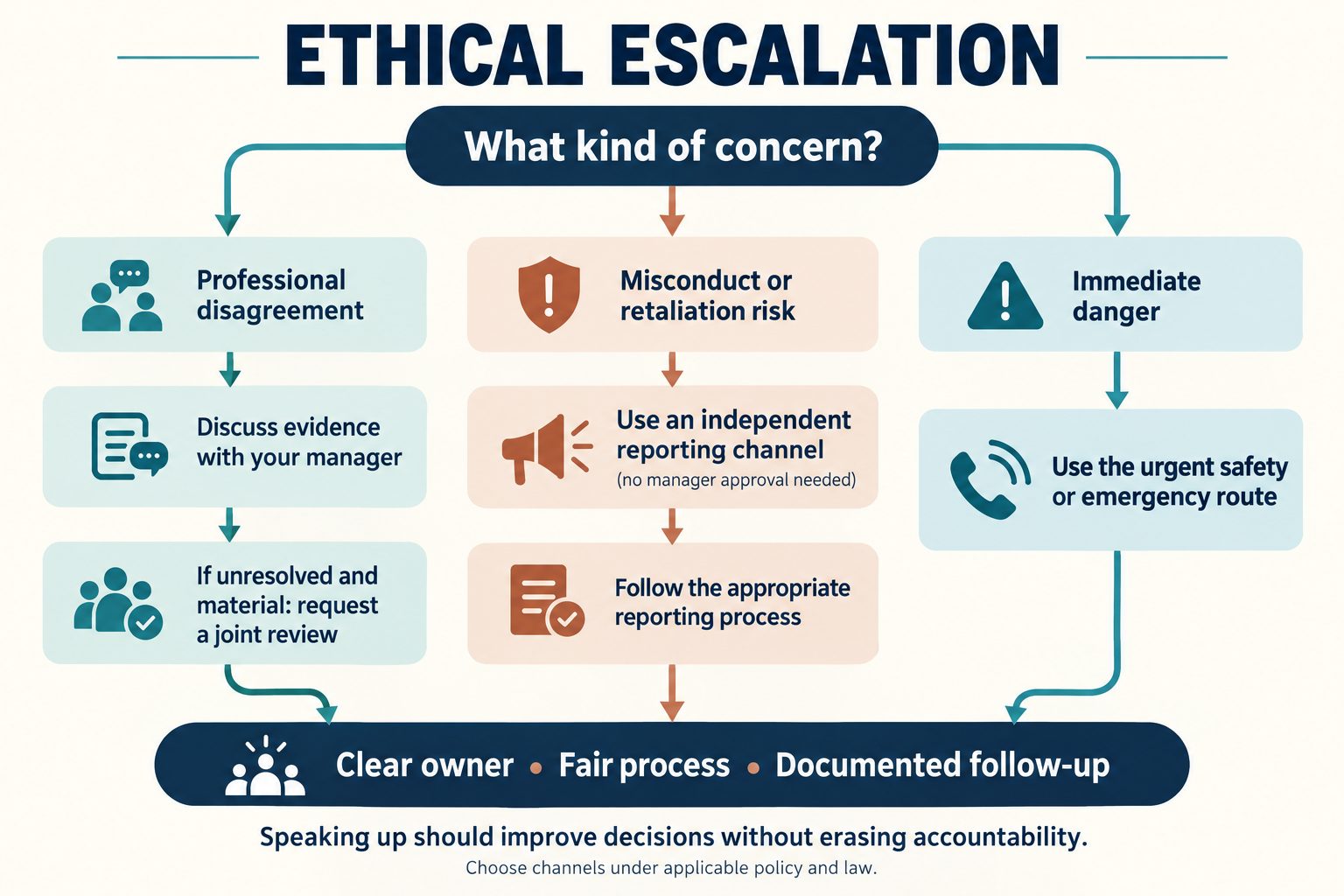
The following is a proposed management framework, not a validated diagnostic instrument. First triage the concern: immediate danger requires the relevant urgent response; suspected misconduct or retaliation risk may require an independent route. The ordinary business-disagreement sequence below should never become a gatekeeping requirement for those cases. For routine issues, organizations can reduce unnecessary conflict by establishing a clear escalation framework.
Step 1: Clarify the Problem
Define the issue before challenging the decision. Is this a matter of personal preference, a difference in professional judgment, or a demonstrable business risk? A disagreement becomes more productive when its consequences can be examined objectively.
Step 2: Challenge Constructively
For ordinary operational disagreements, begin with the accountable manager where appropriate. Present relevant evidence, explain potential consequences, and invite discussion. The goal should be better decision-making, not personal victory.
Step 3: Propose Alternatives
Constructive disagreement becomes more valuable when accompanied by solutions. A controlled experiment, alternative resource allocation, or time-limited trial may resolve the conflict without escalating it.
Step 4: Document the Decision
Record the reasoning, options considered, risks identified, and relevant responsibilities. Documentation improves transparency and makes later review more objective. It should support learning rather than become a weapon for assigning blame.
Step 5: Escalate Transparently When Necessary
If a significant issue remains unresolved, use an established escalation channel. For ordinary business disagreements, this may involve openly requesting a joint review with higher management. State what remains unresolved, what material risk or dependency warrants review, what has already been tried, who should decide, and when a response is needed. Where safe and appropriate, inform the direct manager. Transparency does not require disclosing a sensitive report to the person implicated. For misconduct, retaliation, or other sensitive concerns, independent reporting channels may be more appropriate.
Step 6: Commit, Review, or Pursue Formal Resolution
Once a legitimate decision has been made, the team should normally support its execution. However, commitment should not mean ignoring new evidence, safety concerns, unlawful instructions, or unresolved misconduct. Organizations need mechanisms for revisiting decisions when circumstances materially change. The reviewer should identify the final decision owner, explain any override to the appropriate participants, assign resources, and agree a review date. If authority changes, accountability must change with it.
11. How Can Organizations Detect the Hidden Damage?
Cultural problems often become visible only after they affect employee turnover, execution quality, or operational performance. By then, the underlying patterns may have existed for a considerable time. Leaders can monitor several indicators to identify risks earlier.
| Organizational Indicator | What to Examine |
|---|---|
| Decision Ownership Clarity | Do employees know who has final decision-making authority? |
| Escalation Frequency | How frequently are issues referred beyond the responsible manager? |
| Decision Reversal Rate | How often are decisions changed outside established review processes? |
| Managerial Autonomy | Do managers have authority proportional to their responsibilities? |
| Psychological Safety | Can employees raise concerns without fear of unreasonable consequences? |
| Employee Voice | Are employees willing to share ideas, disagreements, and operational warnings? |
| Conflict Resolution Time | How quickly are legitimate disagreements resolved? |
| Cross-Functional Decision Quality | Are conflicts between departments addressed through clear ownership and evidence? |
These indicators should be interpreted carefully. For example, an increase in reported concerns may indicate deteriorating conditions, but it may also mean employees have gained confidence in reporting channels. Similarly, a low number of escalations does not necessarily indicate a healthy organization.
Use these indicators as prompts for inquiry, not targets for suppressing reports or scoring individual dissent. Review patterns alongside qualitative feedback and protect sensitive case information. The objective is not to minimize disagreement. It is to create a system where disagreement improves decision quality without destroying accountability.
Conclusion: Respecting Hierarchy Without Protecting Dysfunction
Going over your manager’s head is not inherently an act of organizational betrayal. Nor is it automatically a demonstration of courage or professional responsibility. Its value depends on the context, purpose, process, and consequences.
A healthy chain of command clarifies responsibility and supports scalable execution. It should not shield managers from criticism, suppress employee voice, or prevent serious concerns from reaching appropriate decision-makers. At the same time, an organization cannot build a reliable management system if routine decisions are repeatedly bypassed through informal influence.
The greatest danger emerges when organizations fail to recognize this distinction. Some employees may learn to navigate around established structures. Others, particularly during periods of economic insecurity or crisis, may decide that speaking up is not worth the risk.
When these patterns coexist, organizations can lose two essential capabilities at once: clear accountability and reliable upward communication. Over time, this can weaken trust, reduce organizational learning, and make execution less scalable. The solution is not stricter hierarchy at any cost.
Nor is it unrestricted escalation. It is a management system where authority is clearly defined, accountability is fairly assigned, disagreement is genuinely welcomed, and legitimate escalation is protected.
Organizational maturity is the ability to challenge a manager’s decision without having to undermine the manager, escalate a concern without destroying trust, and confront misconduct without sacrificing professional safety.
Ultimately:
A healthy organization should never force employees to choose between respecting the chain of command and doing what is right for the business.
Frequently Asked Questions
Is going over your manager’s head always unprofessional?
No. The purpose, risk, and process matter. An authorized review of an unresolved material concern differs from privately seeking a preferred answer. Misconduct, retaliation risk, or immediate danger can justify a route that does not start with the direct manager.
Should I tell my boss before escalating a problem?
For ordinary business disagreements, explain the unresolved issue and request a joint review where appropriate. If the manager is implicated, disclosure could create retaliation risk, or the matter is sensitive, use the designated independent process instead. Follow applicable policy and law; do not treat manager notification as a universal prerequisite.
What is the difference between workplace escalation and whistleblowing?
Workplace escalation requests review by someone with appropriate authority. Whistleblowing concerns specified wrongdoing and may have particular legal requirements and protections. A routine disagreement or personal grievance is not automatically a protected disclosure. The correct route depends on the issue and jurisdiction.
Can skip-level meetings undermine a manager’s authority?
They can if they routinely become undocumented approval channels. They can also reveal problems that would otherwise remain hidden. Leaders should distinguish listening from deciding, clarify who owns follow-up, and preserve independent handling where a concern involves the manager.
How can leaders encourage employee voice during a crisis?
Make reporting channels accessible, communicate uncertainty honestly, explain how concerns will be reviewed, and follow up on action or inaction. Monitor both suggestions and withheld concerns. Job-insecurity research raises a relevant risk, but it does not prove that every crisis or wartime workplace becomes silent.
Related Reading
For the execution implications, read Beautiful Strategies, Real-World Failures: Why Middle Management Is About Execution, Not Presentations. For another leadership perspective, see My take on The 15 Commitments of Conscious Leadership.
References
- Gallo, A. (2016, December 22). What to Do When a Coworker Goes Over Your Head. Harvard Business Review.
- Gabarro, J. J., & Kotter, J. P. (1980; reprinted January 2005). Managing Your Boss. Harvard Business Review.
- Morrison, E. W., & Milliken, F. J. (2000). Organizational Silence: A Barrier to Change and Development in a Pluralistic World. Academy of Management Review, 25(4), 706–725.
- Morrison, E. W. (2014). Employee Voice and Silence. Annual Review of Organizational Psychology and Organizational Behavior, 1, 173–197.
- Morrison, E. W. (2023). Employee Voice and Silence: Taking Stock a Decade Later. Annual Review of Organizational Psychology and Organizational Behavior, 10, 79–107.
- Detert, J. R., & Edmondson, A. C. (2011). Implicit Voice Theories: Taken-for-Granted Rules of Self-Censorship at Work. Academy of Management Journal, 54(3), 461–488.
- Kish-Gephart, J. J., Detert, J. R., Treviño, L. K., & Edmondson, A. C. (2009). Silenced by Fear: The Nature, Sources, and Consequences of Fear at Work. Research in Organizational Behavior, 29, 163–193.
- Sherf, E. N., Parke, M. R., & Isaakyan, S. (2021). Distinguishing Voice and Silence at Work: Unique Relationships with Perceived Impact, Psychological Safety, and Burnout. Academy of Management Journal, 64(1), 114–148.
- Breevaart, K., López Bohle, S., Pletzer, J. L., & Muñoz Medina, F. (2020). Voice and Silence as Immediate Consequences of Job Insecurity. Career Development International, 25(2), 204–220.
- UK Government. Whistleblowing for employees. Jurisdiction-specific public guidance.